Claude Code Adoption in Engineering Teams Without the IDE
Teams gain unattended work that returns for review, not another chat interface.
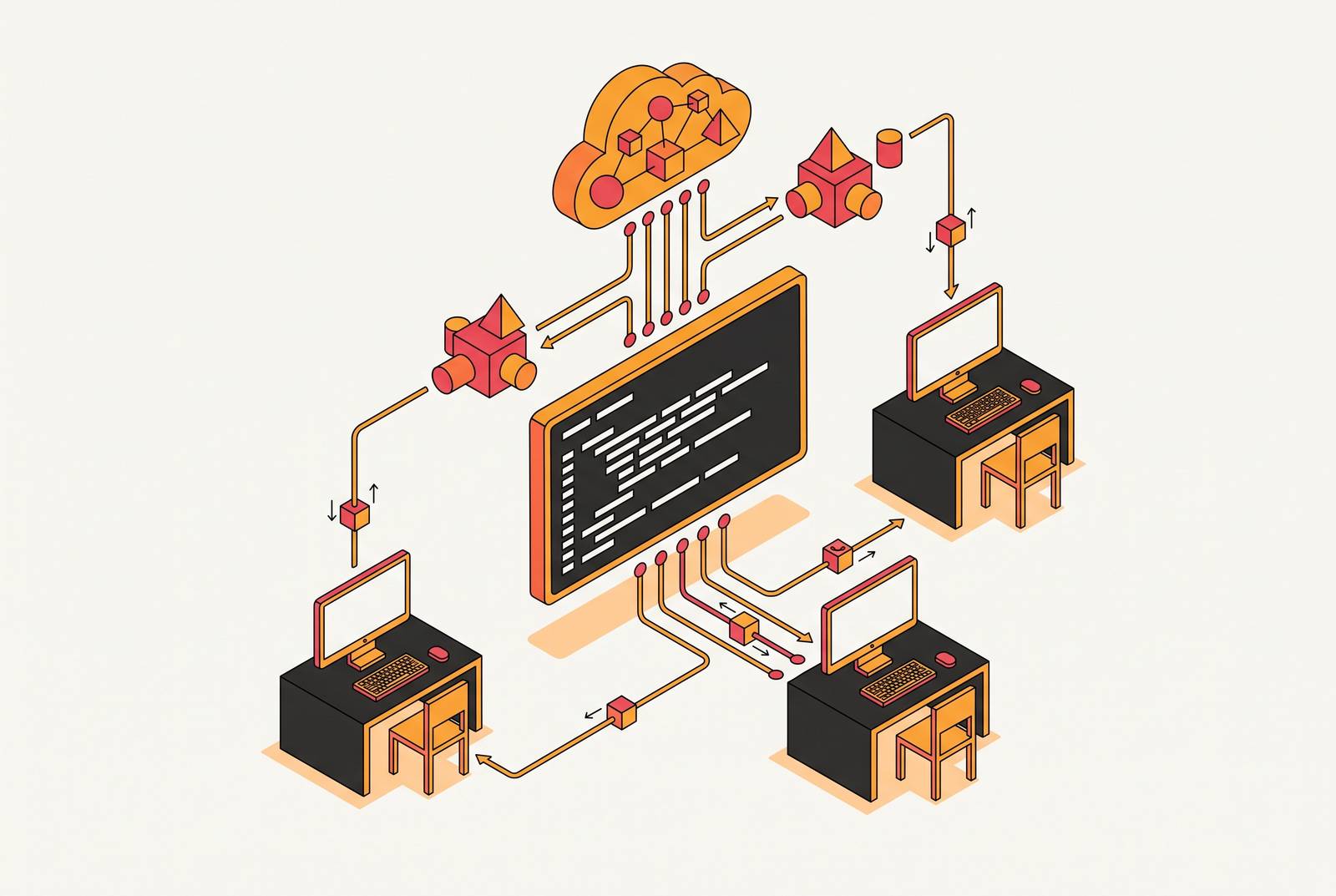
Running Claude Code outside the IDE turns it from a personal assistant into shared engineering infrastructure, provided teams share its instructions, isolate its execution, and measure its output. A multi-harness cloud coding agent platform extends that model by letting teams delegate work to different agents through shared workflows. The decisive capability is not another chat interface, but unattended work that returns for review.
Why terminal-first Claude Code is a team infrastructure question, not a preference
An IDE plugin, personal keybindings, and one engineer’s workflow make adoption depend on the person at the keyboard. That arrangement can support useful individual work, but it leaves the team’s access to the agent tied to an individual session. The architecture determines who can initiate work and under whose rules it runs. Editor preference is a narrower decision. It does not settle how a team delegates, governs, or reviews autonomous work.
Claude Code crossed a multi-billion-dollar annual run rate in 2026, taking it past pilot experiments and into enterprise procurement, security reviews, and budgets set aside to pay for it. That commercial depth changes the standard by which a rollout should be judged. A purchased seat establishes access. Shared infrastructure needs rules that carry over from one session to the next and execution environments that can run without someone’s workstation.
A terminal session can remain just as personal as an IDE session if its instructions and permissions belong to one engineer. The infrastructure shift happens when those dependencies become team-owned. Terminal, CI, and workflow integrations then let people start work with the same agent under the same rules.
What decoupling the agent from the IDE actually unlocks
The IDE era of 2024–2025 brought models into editors and gave them full repository access. The underlying capability came from the agent loop and codebase reasoning. Larger context windows expanded what could fit into a single session, including work that had previously required tickets, design documents, and multi-week sprints. The editor made that capability immediately accessible. It did not define its full range.
Running from the terminal changes the engineer’s relationship to that loop. Instead of co-editing line by line, the engineer can issue instructions and review the result while the agent chains tool calls, runs tests, and checks its work. Separating human attention from individual steps makes unattended execution possible, although the safety and reliability of a run still depend on its surrounding infrastructure.
Anthropic shipped Claude Code Routines in April 2026 as scheduled, stateless cloud agents that run on a cadence, through an API call, or in response to a GitHub event. This adds a different unit of work. An engineer can start agents before leaving and review a stack of pull requests the next morning. IDE-centric usage cannot reproduce that overnight or webhook-triggered pattern without significant constraints, because the work must proceed independently of an active editing session.
CLAUDE.md as the mechanism that makes agent behaviour shared rather than personal
Once execution no longer depends on an engineer being present, instructions cannot depend on that engineer remembering what to explain. CLAUDE.md becomes the team contract for how the agent approaches the repository. The highest-return investment in a rollout is therefore the shared skill kit and project memory. Their quality determines how much useful context survives between sessions. A successful installation says little about that quality.
The root file should stay short and scoped. A document that tries to explain the whole company makes repository-wide guidance compete with knowledge relevant only to a particular directory. Nested CLAUDE.md files keep local knowledge with the code that needs it, while the root file holds the rules that apply across the repository. A rule belongs at the level where it governs the work.
Durable rules also need separation from task-specific prompts. Plans, decisions, and research belong in persistent markdown files so that a later session need not reconstruct every earlier conclusion. This gives project memory a distinct purpose from instructions. The team contract establishes how work should proceed, while task records preserve what has already been learned. Keeping both deliberate and concise makes shared behaviour less dependent on the person who starts the run.
Sandboxed environments as the prerequisite for safe autonomous runs
Instructions establish intended behaviour, but they do not enforce execution boundaries. An agent that can install packages, run services, and change the filesystem without isolation is not safe to run autonomously. Anthropic’s security model separates three kinds of control. Permissions govern tools and commands, MCP controls govern access to external systems, and OS-level sandboxing enforces filesystem and network boundaries. Each addresses a different failure mode.
Anthropic uses Seatbelt on macOS and bubblewrap on Linux for OS-level sandboxing. No network domains are pre-allowed by default, and new domains trigger a user prompt. Anthropic reports that its sandboxed Bash implementation reduced permission prompts by a large margin.
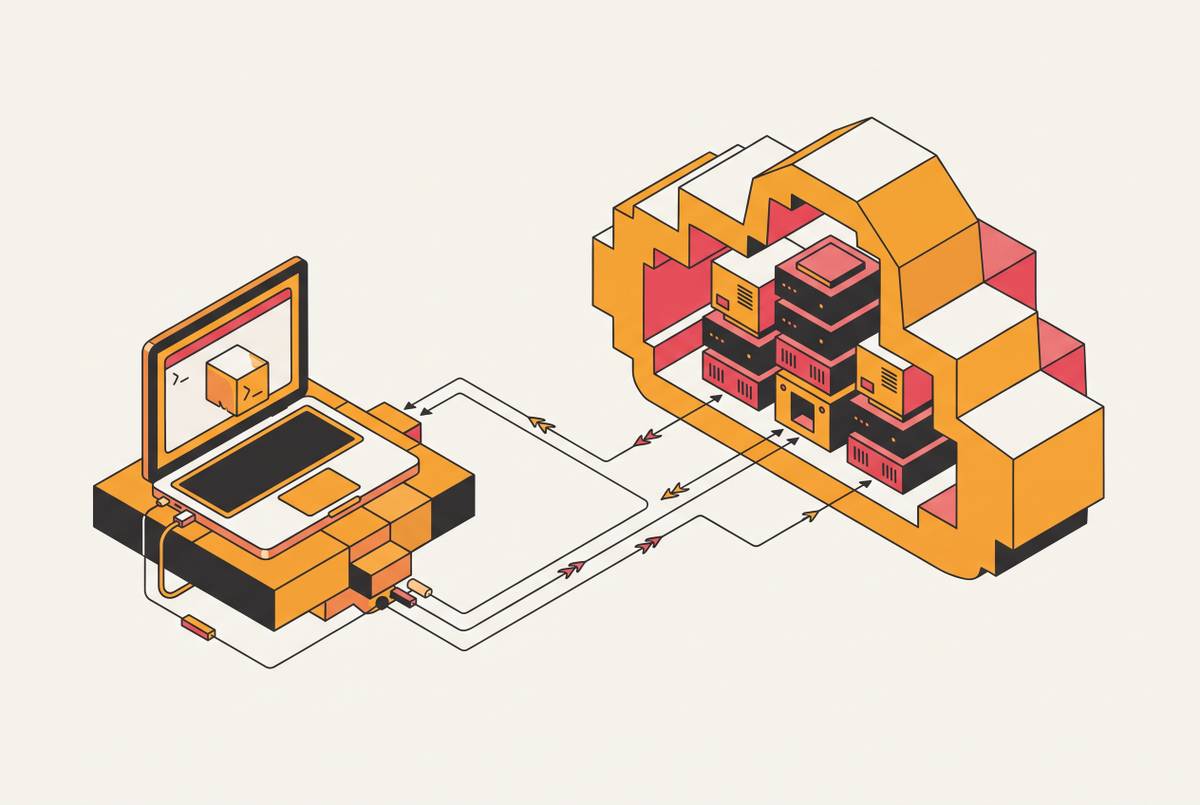
As autonomy increases, teams also face a choice about where tool execution belongs. Anthropic announced self-hosted sandboxes and MCP tunnels for Managed Agents at Code with Claude London in May 2026, following the platform’s April public beta launch. The agent loop stays on Anthropic’s infrastructure, while tools execute in the team’s configured environment. This serves teams that need files, repositories, and credentials to remain within their own infrastructure.
Cloudflare provides lightweight virtual machines with customisable egress proxies, while Daytona provides stateful machines accessible through SSH. Modal targets AI workloads with sub-second startup, and Vercel provides VM security with VPC peering. All four are in public beta. Separately, Anthropic’s beta sandbox runtime lets teams restrict directories and network hosts for arbitrary processes, agents, and MCP servers without managing a container.
How engineers can trigger Claude Code from Slack and get back a pull request
With an execution boundary established, the next question is how work reaches the agent. In the Slack-to-PR pattern, an engineer posts an @Claude request in a thread. Claude gathers context from the conversation, creates a cloud-based instance, performs the task, and generates a pull request. Delegation does not require leaving the conversation.
Slack Code, launched in August 2026, places that pattern in a multiplayer coding environment. Agents from Anthropic, GitHub, Cognition, OpenAI through ChatGPT, and Vercel work with people in shared channels. Assigning a task creates a dedicated channel containing the relevant agents and people. The shared channel becomes the coordination surface. Engineers can work on the same delegated task while keeping their own workflows.
Linear extends this model upstream into issue creation and assignment. Linear’s platform data shows sharply rising PRs per team, greater code contributions from non-engineers, and agents authoring roughly half of all issues. Its direction is explicitly toward agents as the primary end user of an integrated development platform. Work intake is changing with execution. The issue no longer has to end with a human manually starting an agent session.
GitHub lets events start work and brings the results back as pull requests for review. Routines can respond to GitHub events, allowing repository activity to initiate work independently of an editor. MCP supplies supporting infrastructure through controlled access to external systems where needed. The important continuity is from a request in a shared system to an output that enters the team’s review queue.
How harness choice affects what autonomous runs can actually do
A shared trigger does not make the agents behind it interchangeable. Claude Code, Codex, and Cursor represent distinct working patterns, with different strengths for work outside an interactive editing session. Claude Code lets engineers talk with it in the terminal and gives it direct filesystem access, which makes it a good fit for complex multi-file refactoring and reasoning about large codebases. It leads on a verified software-engineering benchmark with Opus 4.6. Its large standard context window and expanded beta context help it work with those codebases.
Cursor centres on real-time visual editing as a VS Code fork, making interactive inline work its clearest strength. Many professional teams use Codex for tasks that run on their own in the background. Teams can use Cursor for daily editing, Codex for background tasks, and Claude Code for refactors that require deep repository context.
The advertised context window alone cannot show that the agent will have all the code it needs throughout a task. Truncation can weaken large-codebase analysis without an engineer noticing during execution. Interactive and unattended work tolerate that risk differently. The latter depends more heavily on the harness maintaining the context needed to finish correctly.
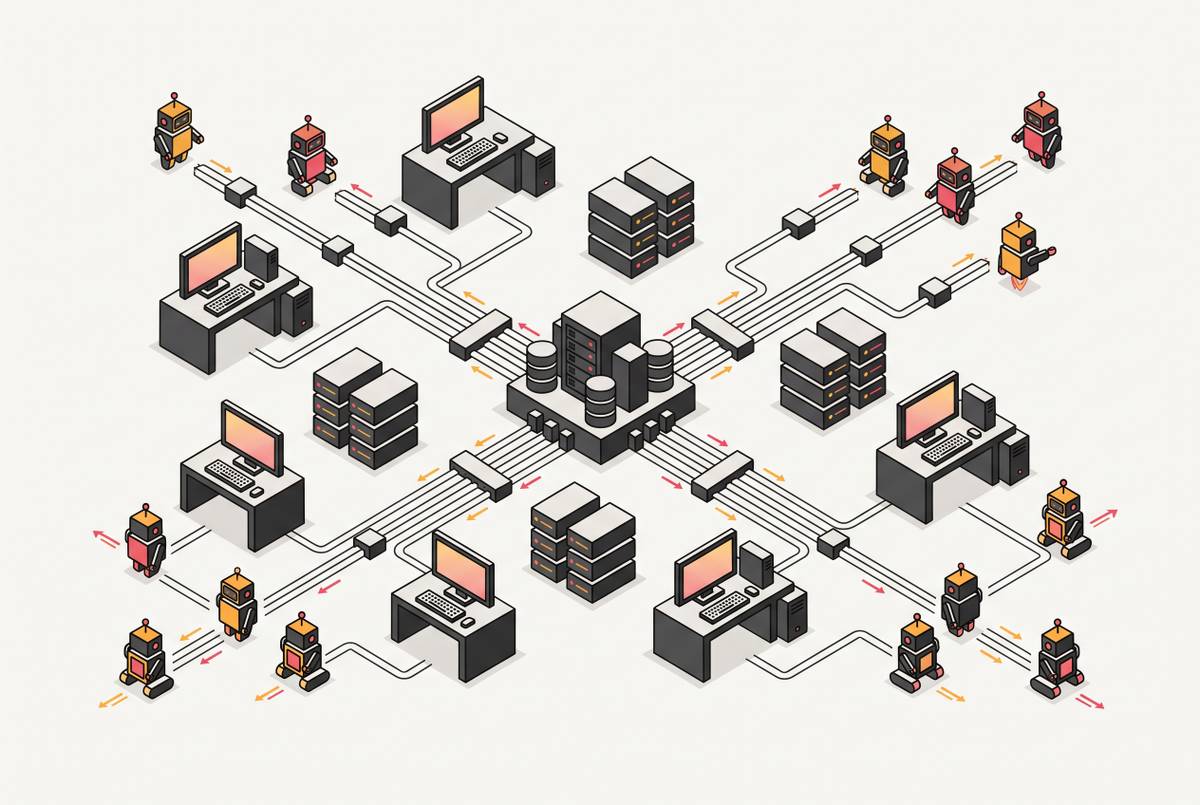
For a multi-harness cloud coding agent platform, the buying criteria therefore extend beyond a model menu. The relevant distinctions include support for different task patterns, isolated execution, shared triggers, and reviewable outputs. A cloud VM does not by itself establish multi-agent support, while multiple agent choices do not establish safe autonomous execution. When infrastructure forces a team to use a single harness, the way the team works depends on that harness still fitting its needs as models change.
Measuring what the agent actually shipped, not just that it ran
Once autonomous runs return pull requests, it is easy to count how much they do. Lines accepted, suggestion acceptance rates, and daily active users establish that people used the tool, but they do not establish shorter cycle times, lower review load, or fewer defects. PR counts also leave those questions open. More output may still require more human attention. Engineering leaders need to distinguish contribution from delivery performance.
Anthropic recommends pairing contribution metrics with DORA metrics or sprint velocity. Doing so requires connecting Claude Code usage data with systems such as GitHub or GitLab, Jira or Linear, CI/CD, and incident or release records. An engineering intelligence platform is another way to bring that data together. The purpose is to connect activity with delivery. A native usage dashboard answers only part of the question.
Microsoft’s early-2026 rollout study of tens of thousands of engineers provides stronger evidence than adoption counts alone. Adopters merged roughly a quarter more pull requests than they would have otherwise. The study also found a statistically significant within-person increase in merged PRs during weeks with Claude Code use compared with the same engineer’s zero-tool weeks. Teams still need to measure review burden and defects on their own.
Its original productivity panel tracked vanity counts and seemed to show no change for six weeks. Re-weighting the panel around skill invocations and subagent runs exposed the adoption curve and changed leadership’s interpretation. Engagement-weighted measurement showed how usage was developing. It complemented, rather than replaced, the need to measure what that usage delivered.
How a phased rollout turns individual terminal usage into team-wide operating model
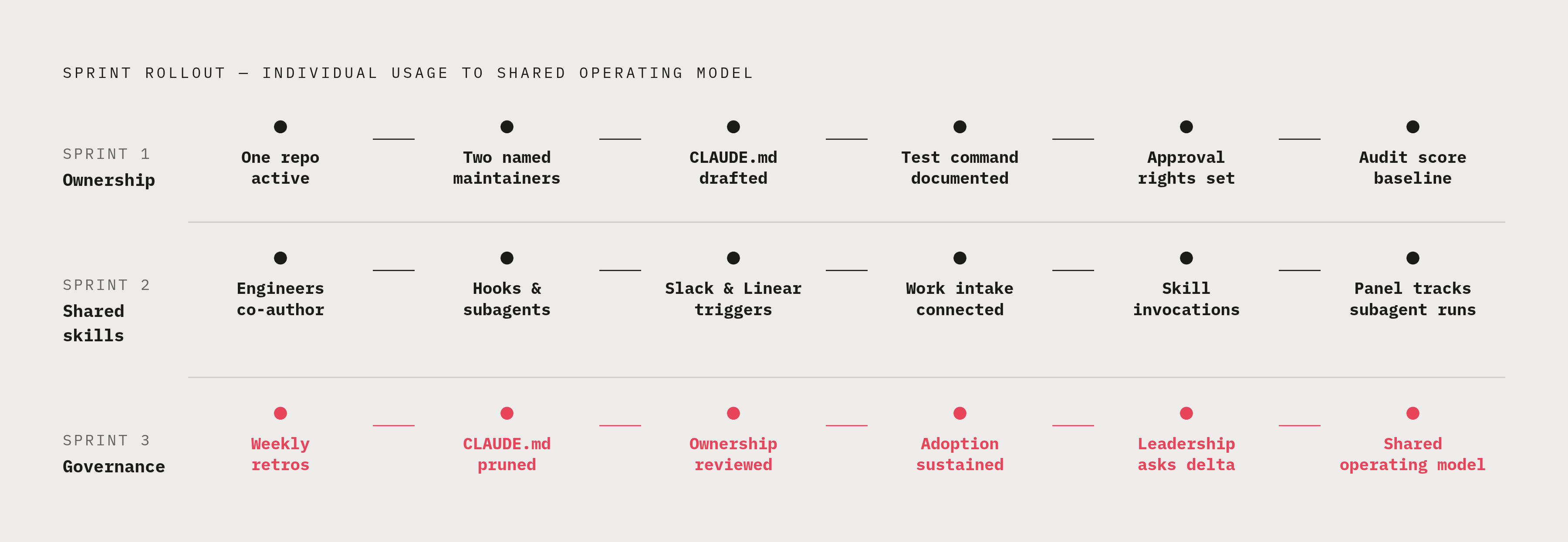
The first sprint establishes one active repository and two named maintainers, with a concise CLAUDE.md and a documented default test command. It also lists the systems Claude may read and assigns approval rights for changes to the conventions file. Ownership is explicit from the start. The baseline is the audit score.
The second sprint moves from installation to leverage. Multiple engineers author shared skills, rather than leaving that work to the staff engineer leading the rollout. Hooks and subagents enter the workflow, and Slack or Linear trigger points connect shared work intake to execution. The productivity panel changes with the operating model. Skill invocations and subagent runs reveal whether the team is using the capabilities it has built.
The third sprint establishes governance through weekly squad retrospectives. Permission problems, skill-discovery gaps, and hook noise can then be identified in weekly squad retrospectives in the week they occur, before they accumulate for a quarter. CLAUDE.md ownership is reviewed, and the file is pruned again. Maintenance becomes part of adoption. This keeps shared instructions and the way agents run in step with the problems engineers face.
Leadership can then ask a more useful question than whether Claude Code is being used. The test is what the team can do today that it could not do six months earlier. Evidence includes maintained CLAUDE.md files, committed skills, hooks, and subagent runs, interpreted against delivery outcomes. Seat counts cannot demonstrate that change. Shared infrastructure becomes visible in the work the team can delegate and the results it can responsibly accept.