Local vs Cloud Coding Agents for Engineering Teams
Execution environment now matters more than model quality for engineering team productivity.
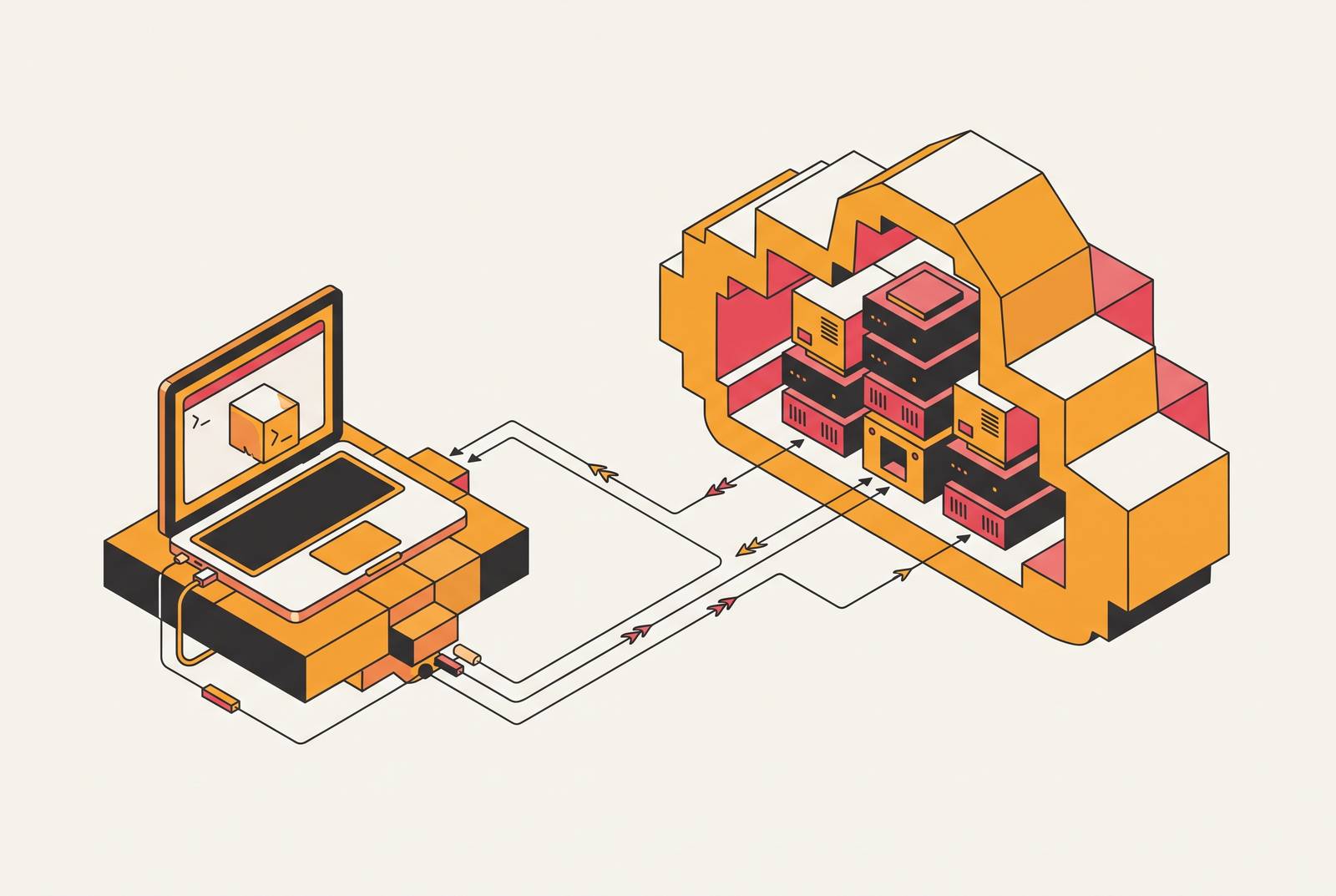
The coding-agent market crossed a real threshold in 2026. That shift changes which variable now decides whether the work goes well. Model quality still matters, but the execution environment, where the code runs, who or what owns the process, what the agent is allowed to touch, now does more to decide the outcome. Industry commentary on the 2026 product surface has settled on three distinct layers: the IDE for real-time collaboration, the CLI for local execution, and cloud agents for asynchronous delegation. These layers solve different problems, and treating them as interchangeable is where most of the confusion about "which tool is best" comes from.
Anthropic's 2026 Agentic Coding Trends Report describes this as one of the more significant changes to the software development lifecycle in recent memory: sequential handoffs are giving way to a more fluid agent flow, and the old model of a human coding everything is giving way to a human guiding while the agent executes. JetBrains' Developer Ecosystem Survey 2026 found that 90% of professional developers were using AI coding agents at work at least weekly. Adoption is no longer the open question. What teams run those agents on, and what that choice costs them in review time, security exposure, and reliability, is the open question now.
Local Agents: Where Their Limits Surface
Local agents, whether CLI-based or attached to an IDE, earn their place by sitting close to the developer's actual toolchain. For an experienced developer who wants to watch every step and intervene immediately, that proximity is a genuine advantage. Nothing is hidden behind an API call to a remote machine; the agent runs where the developer already works, and the developer can inspect everything it does in real time.
The same proximity is also the source of its limits. The developer is present anyway, so sharing machine state costs little.
The trouble starts with a different class of task: work that is bounded and testable but takes a long time to grind through. Local execution isolates a task for synchronous work where the developer stays in the loop, but it creates friction exactly where teams want to walk away and let the work finish unattended. Cloud execution shifts that economics by isolating each task in its own environment, so the developer doesn't have to be present or exposed to the blast radius of a bad run.
What cloud agents need from an environment
The case for cloud agents does not rest on better models. It rests on what kind of environment reliable, delegated engineering work actually requires, and on the fact that a developer's own machine cannot structurally provide it. All of that has to happen without touching production and without leaking state into whatever else is running on the same machine.
Giving an autonomous agent unrestricted access to infrastructure is a security risk in its own right, independent of how good the underlying model is. Isolation isn't a nice-to-have layered on top of a working setup. Three isolation approaches are in active use today, and they trade off security against overhead in different ways. Hardened containers sit at the bottom of that stack: adequate for code a team already trusts, but not built to contain arbitrary agent-generated execution.
A gap separates the sandboxes built into tools like Claude Code, Codex, and GitHub Copilot, which exist primarily to keep an agent from doing damage, from infrastructure platforms that give an agent a full, governed environment in which to actually verify its work. Agent-native sandboxes can run a unit test suite, but they typically cannot deploy to a real environment or hand back a working preview URL. Anthropic's 2026 Agentic Coding Trends Report treats this orchestration shift as part of the same foundational change: agents that now handle entire implementation workflows, writing tests, debugging failures, generating documentation, need an environment that matches the scope of that work, not just a safety net around it. Cloud agent platforms like Replicas are built around that exact constraint, offering isolated Linux virtual machines pre-loaded with a team's own codebase and tooling rather than treating the environment as something bolted on after the fact.
A natural objection follows: why not just give a local agent more permissions and run it on a better machine? Platforms that give agents a governed, full-stack environment per task, Replicas among them, spin up a dedicated virtual machine for each run specifically so that this scope of work stays safe and repeatable at delegation scale.
How context engineering changes what the environment must support
Isolation is only half of what an environment needs to provide. The agent's ability to know what the codebase expects of it before it starts working matters just as much. Developer communities converged, over the course of 2026, on context engineering as the real differentiator between agentic workflows that work and ones that don't. In practice that means files like CLAUDE.md and AGENTS.md sitting at the repo root, alongside Model Context Protocol references and tool definitions that give an agent tight, specific boundaries for the task in front of it. An agent that knows the team's conventions, its test commands, and its deployment constraints before it starts behaves differently than one guessing at all three.
Local context has a structural weakness: it lives with the individual, not the team, even though a disciplined engineer can maintain excellent context on their own machine. A cloud environment that pre-loads dependencies, tooling, and context artifacts before every run turns context into something the team owns collectively rather than something each developer carries around individually. Every run starts from the same configured baseline, regardless of who triggered it.
The same logic extends to how teams manage the tools an agent can call through MCP. Every one of those is easier to enforce consistently in a governed cloud environment, where the policy applies to the infrastructure itself, than across a fleet of individual developer machines, where enforcement depends on each engineer applying the same settings correctly.
The cloud agent review bottleneck and how environment design fixes it
Cloud agents generate code faster than teams can reliably review it, and that gap appears as measurable delay at the review stage. The bottleneck sits at pickup, not inside the review itself. That distinction matters because it points to where the fix has to live: not in slowing the agent down, and not in demanding a better model, but in how the surrounding workflow is configured.
Quality compounds the problem. A pull request that gets generated in minutes but then sits unreviewed for days, and is more likely to bounce back for rework once someone finally looks at it, erodes most of the time savings the agent was supposed to deliver.
Teams that have handled this well did it at the environment level. Automated CI gates that block any pull request over a defined line count from entering the review queue, paired with agent system instructions that force large tasks to be broken into smaller PR batches, function as a single configuration change that reduces pickup time, raises acceptance rate, and shortens the review cycle all at once. LinearB's case study on Syngenta's workflow restructuring illustrates the underlying pattern: a metrics program built around core engineering health indicators, including PR size, paired with workflow automation, drove measurable reductions in pickup and review time. That kind of policy only holds consistently when the agent runs inside a governed cloud environment where the rule applies to every run by default. A policy that depends on each developer remembering to configure PR size limits locally will apply inconsistently across a team, undermining the rule's purpose.
How the leading harnesses divide by execution model
The major coding harnesses available to engineering teams in 2026 don't just differ on model quality or price. They divide on execution model, and that division determines what kind of environment each one actually needs to run well.
Claude Code is reasoning-heavy and holds its own in long, tool-heavy sessions that carry complex context across many steps, which makes it well suited to ambiguous or frontend-heavy work where judgment matters as much as output. JetBrains' Developer Ecosystem Survey 2026 found it had become the most widely adopted AI coding tool at work, used by roughly two-fifths of professional developers worldwide and close to half in the United States. The same JetBrains survey noted roughly fivefold adoption growth for Codex in the first half of 2026. Because its model depends on running many tasks in parallel, it needs isolated, per-run environments more than almost any other harness, since cross-contamination between simultaneous runs would undercut the entire point of running them in parallel.
OpenCode takes a different approach: open-source, terminal-native, and flexible about which underlying model it runs. It suits teams that want direct control over that choice. Because it asks more of the team setting it up, it benefits more than most from running inside a pre-configured cloud environment. GitHub Copilot remains the most mature enterprise option, with deep integration into GitHub itself, broad support across editors, and a compliance posture suited to large organizations. JetBrains' survey found Copilot still commands the broadest awareness among developers worldwide, even as Claude Code has overtaken it in weekly use.
A clear pattern falls out of these four. Harnesses built for true asynchronous delegation, Codex and Copilot's agent mode among them, need per-run isolation to work reliably once usage scales up. Harnesses that shine in interactive sessions, Claude Code running in CLI mode being the clearest case, can run locally just fine but scale better once the environment is pre-configured and every run is logged with clear attribution. Most serious engineering teams end up using more than one harness in practice, planning in Claude Code and then executing in Codex is a common pattern, and locking into a single harness risks falling behind as capabilities shift month to month. That raises a question that sits above any individual tool choice: who manages the execution surface once a team is running three or four different harnesses at once?
Running cloud coding agents at team scale: what Replicas provides that the harnesses do not
Replicas answers that question by treating the execution environment itself as the product, rather than building it as a byproduct of one specific agent. Every run executes inside its own sandboxed virtual machine, pre-loaded with the team's own dependencies and tooling, so an agent can install packages, start services, drive a browser, and check its own work much as it would on a real developer's machine, without the risk of leaking state into another run or into production.
Harness-agnosticism is built into the platform from the start. A team can delegate the same kind of task to Claude Code, Codex, or OpenCode depending on what that specific task calls for, without being locked into whichever single agent's execution model the infrastructure happened to be built around. That flexibility is the direct answer to the problem the previous section raised: a team using several harnesses doesn't need to pick one infrastructure layer per harness, it needs one infrastructure layer that works across all of them.
Replicas connects into the places engineering work already happens, Slack, Linear, GitHub, GitLab, so an engineer can trigger an agent run from a Linear ticket or a Slack message and get back a pull request, a recording of the session, or a reply, without learning a new interface or adopting a separate tool just to delegate work. That level of tracking is the team-scale answer to a measurement problem that individual local agents simply cannot solve, since there's no equivalent record when ten developers are each running agents on their own machines with their own settings. The review bottleneck described earlier becomes addressable the same way: CI gate policies and agent instructions that cap pull request size apply consistently across every run inside the platform, rather than depending on each developer remembering to set that policy up locally, which is precisely where locally-triggered agents tend to fall short.
Matching the task type to the right execution environment
The right environment for a given coding agent task comes down to three questions: how much isolation the task needs, how long it's going to take, and whether it needs to be governed and attributed at the team level. None of those questions are answered by checking which model scores highest on a benchmark.
A quick debugging pass or a focused refactor, done with a developer watching every step, is well matched to local execution, whether through a CLI tool or an IDE-attached agent. Bounded but time-consuming work, dependency upgrades, test coverage, mechanical fixes across a large codebase, is where local execution starts to cost real time, since it ties up a developer's machine and attention for a task that doesn't need either. That is the class of work cloud execution was built for: isolate the task, let it run unattended, and bring back a pull request when it's done.
At the scale of an entire engineering team running several harnesses across dozens of engineers, the decision becomes one of infrastructure: every run must be isolated from every other, context and tool access must be governed consistently, and the team must be able to see, after the fact, what ran, on what model, and who it belonged to. Those are environment questions before they are model questions, and teams that treat them that way end up with faster review cycles, fewer contaminated runs, and a clearer picture of what their agents actually did.